
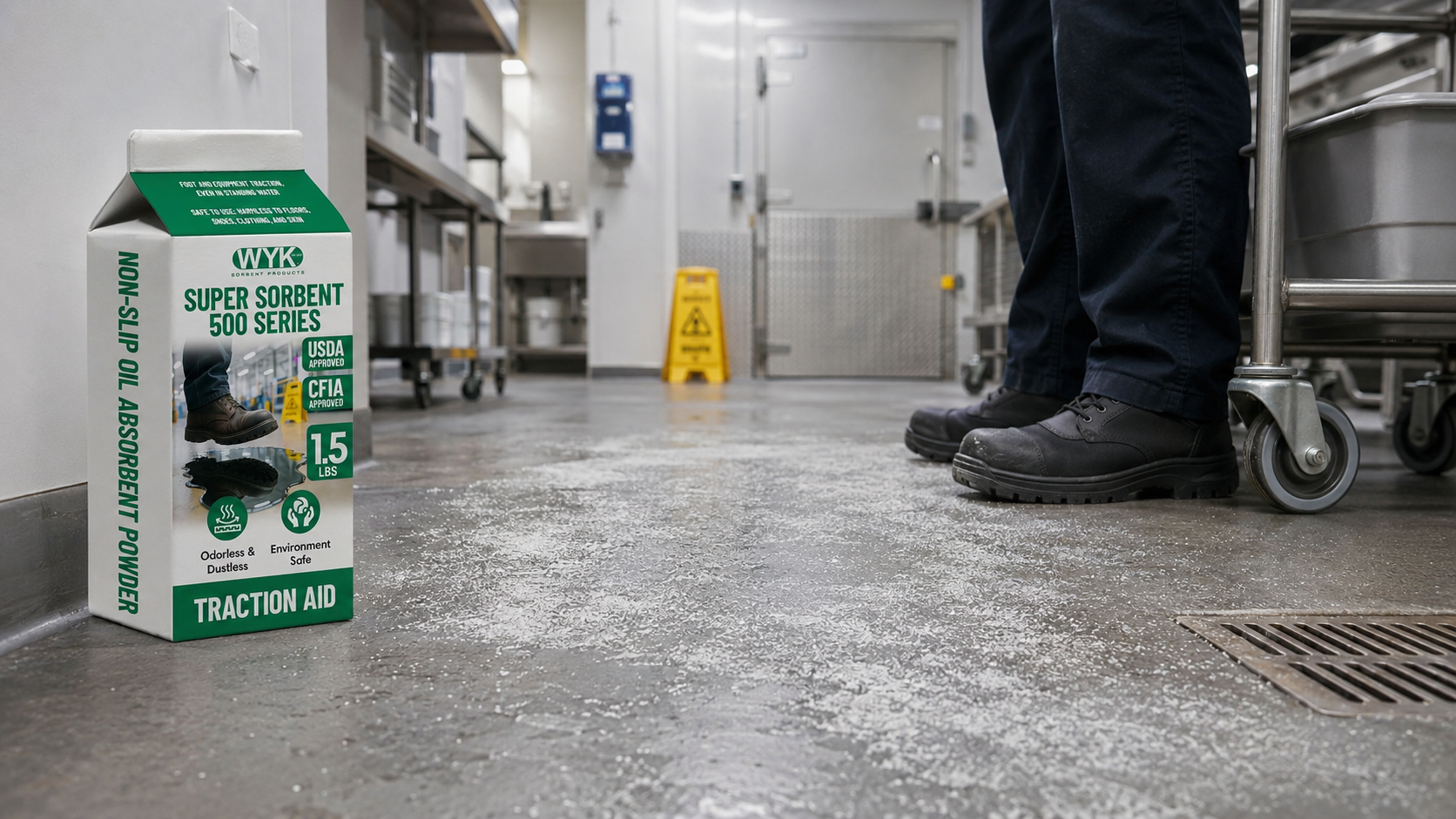
If you’re trying to keep a wet or greasy floor from putting someone on their back, this WYK Safety Sorbent review covers what it is, where it works, and whether it’s worth buying. WYK Safety Sorbent is an anti-slip granular absorbent made from volcanic-ash mineral: it soaks up oil, water, and coolant and leaves a gritty, non-slip layer behind.
We work with butchers, food processors, warehouse crews, and shop owners every day, so this leans on what the specs actually confirm and where a granular absorbent like this earns its place, not marketing. Here’s the honest picture before you buy.
TL;DR
WYK Safety Sorbent (500 Series) is the anti-slip one in WYK’s lineup, a granular absorbent that soaks up a spill and leaves traction underfoot in the same move.
It’s made from amorphous mineral silicate (a volcanic-ash mineral), it’s been in commercial use since 1967, and its own Safety Data Sheet backs up the claims that matter: certified free of respirable silica, non-flammable, and no California Prop 65 warning.
Here’s how to know which WYK granular absorbent is best for your business.
| Use | Why use WYK Safety Sorbent | What size to buy |
|---|---|---|
| Butcher and meat-processing floors | Cuts through the fat-and-water film and leaves grit for grip, and it’s USDA and CFIA authorized for inspected facilities | Shaker cartons or a 12-pack at stations |
| Cold storage and freezer floors | Stays intact on ice instead of turning to paste, so it grips where clay fails | Shaker cartons or a 12-pack |
| Loading docks, ramps, and stairs | Holds up under forklift and foot traffic, gives traction on sweating concrete | 12-pack or bulk bag |
| Auto shop and garage floors | Soaks up oil and coolant and leaves a dry, non-slip patch so techs don’t slip | Bulk bag |
| Commercial kitchen floors | Absorbs hot grease before it films the tile, and it’s dust-free enough for food-prep areas | Shaker cartons or a 12-pack |
| Wet or greasy production lines | A thin border line keeps drips from spreading and holds traction along the line | Bulk bag |
Bottom line: if your problem is a slick floor and the slip risk that comes with it, WYK Safety Sorbent is a strong anti-slip granular absorbent with a long track record and clean safety paperwork. The one job it isn’t for: anything involving hydrofluoric acid.
What Is WYK Safety Sorbent?
WYK Safety Sorbent is the anti-slip granular absorbent in WYK’s line, sold as the 500 Series. It’s a fine gray mineral made from amorphous mineral silicate, the volcanic-ash kind, and it does two things at once: it pulls in oil, water, coolant, and most other liquids, and the sharp mineral grit it leaves behind gives a floor traction. WYK has made it since 1967, so it isn’t a new product finding its footing.
Its sibling, WYK Super Sorbent (2000 Series), is the higher-capacity version built to soak up more per pound. Safety Sorbent is the one to reach for when traction is the point, keeping people upright on a wet or greasy floor.
What the Safety Data Sheet Actually Confirms
A lot of absorbents make claims. What sets WYK apart for a cautious buyer is that its own SDS backs the important ones up:
- Made from amorphous mineral silicate (99.98%), with a tiny anti-dusting compound.
- Certified free of respirable silica by NIOSH Method 7500 and X-ray diffraction. That matters because traditional clay and diatomaceous-earth absorbents can carry crystalline silica, the kind tied to lung damage.
- Non-flammable, with a melting point of 2300 C and NFPA fire rating of zero.
- No California Prop 65 warning, and not listed as a carcinogen by OSHA, IARC, or NTP.
- Non-hazardous under CFR 1910.1200, and not a regulated dangerous good for shipping.
- Odorless, and clean unused product is even safe to use as a soil additive.
That’s a documented safety record, not just packaging copy, which is worth a lot when you’re putting a product on a food-plant floor.
Why WYK Safety Sorbent Beats Clay Floor-Dry for Anti-Slip Traction
The whole point of a floor absorbent is a floor people can walk on safely, and that’s exactly where cheap clay floor-dry fails: it soaks up the spill but leaves the floor slick. WYK Safety Sorbent is built the opposite way, to leave anti-slip traction behind.
Facility crews, machinists, and cleaning teams have run into the same three headaches with clay for years, and here’s why WYK grips where clay slips.
Traction: WYK Grips Where Clay Turns to Mud
WYK stays gritty when it’s saturated, so a wet patch still gives grip. The most common complaint about cheap clay is that it makes the floor more dangerous, not less.
- Why businesses stopped using clay: crews describe a pile of floor-dry that just holds the coolant on top as a slippery mud that gets tracked through the whole shop. Clay soaks up liquid but breaks down doing it.
- Why WYK is different: its volcanic-ash mineral holds its shape instead of dissolving, so it keeps biting into the floor even when saturated.
- The payoff: soaking up the spill and leaving grip behind is the whole reason it exists.
Dust and Silica: Safer to Breathe Around
It’s low-dust and certified free of respirable crystalline silica. Dust is both a mess and a health issue, especially in trades where people breathe near it all day.
- The clay problem: cheap absorbents kick up a cloud, and the crystalline silica in traditional clay and diatomaceous-earth products is a documented exposure.
- Why WYK is different: its Safety Data Sheet certifies it free of respirable crystalline silica by NIOSH Method 7500, and it’s low-dust by design.
- The payoff: for a food-prep area or an enclosed shop, cleaner air matters more than a few dollars on the sticker.
Volume: Fewer Bags, Less Waste to Haul
It absorbs up to 4x more than clay, so you buy fewer bags and haul less weight. Facilities burn through absorbent by the dozens of bags, and every saturated bag is weight you pay to dispose of.
- The clay problem: crews describe going through 60 bags at a time or reordering weekly and still running short.
- Why WYK is different: its own figures put it at up to four times the absorption of clay, with a shaker carton covering about 200 square feet and lasting roughly three small-spill cleanups.
- The payoff: fewer reorders, less storage, and less waste to haul, so the value isn’t the sticker price against a $6 bag of clay, it’s everything downstream of it.
Where You Can Use WYK Safety Sorbent
This is the part worth reading slowly, because a granular absorbent like this fits far more places than most buyers realize. Below are the settings where it does the most good, each with a suggestion on how it’s actually put to work. If you recognize your own floor here, that’s the sign it belongs in your building.
1. Butcher and Meat-Processing Floors

This is the job WYK built it for. Raw fat, blood, and cold washdown water combine into a slick film that mopping only spreads around.
A light “salt and pepper” dusting broadcast across clean, damp cut-room floors and around deboning tables at the start of a shift cuts through that fat-and-water film and leaves a stable grit that keeps butchers upright. Sweep up the spent granules at the end of the shift to keep things sanitary.
- Best for: meat, poultry, and seafood processors, slaughterhouses, and cut rooms
- How people use it: broadcast a light layer on clean damp concrete at shift start; sweep up the organic-saturated grit at shift end
- Best size: shaker cartons at each station, or a 12-pack for a busy floor
2. Cold Storage, Freezers, and Refrigerated Trailers

Ice traction is where it really separates from clay. Humid air hitting a cold floor freezes into thin, treacherous sheets, and clay just turns to paste. Because the volcanic mineral stays intact and doesn’t dissolve, a light dusting on freezer thresholds, doorways, and icy paths embeds into the frost under foot traffic and makes a rough, sandpaper-like path.
If the ice melts, it soaks up the water film without losing its grit.
- Best for: walk-in freezers, cold-storage lockers, refrigerated trailers, chiller portals
- How people use it: a light even dusting on high-traffic thresholds and slip-prone doorways
- Best size: shaker cartons or a 12-pack kept by the cold-room doors
3. Loading Docks, Ramps, and Stairs
It holds up where people carry loads. Unsealed concrete and steel dock plates sweat badly in humid weather, and once condensation mixes with rainwater or yard dust, forklift tires and boots lose their grip.
A light dusting across sweating dock plates and ramps gives immediate traction, and a barrier line of granules at the rain line catches blowing water. Because the mineral resists crushing, it keeps working under heavy loads.
- Best for: loading bays, transition ramps, dock plates, exterior stairways
- How people use it: dust the ramp surface before loading; lay a barrier line where rain blows in
- Best size: a 12-pack for regular use, or a bulk bag for a big dock
4. Auto Shop and Garage Floors
It keeps techs on their feet around a fresh spill. Oil, coolant, and transmission fluid under a lift make polished concrete dangerous. When a leak happens, ring the spill with granules to stop it spreading, cover the center, give it a few minutes to soak, then work it into the concrete with a stiff push broom or a wood block underfoot.
Sweep up the clumped debris, then leave a light dusting over the spot as a dry, slip-resistant patch.
- Best for: auto shops, garages, fleet maintenance bays, machine shops
- How people use it: ring the spill, cover, work it in with a broom, sweep, then leave a light traction layer
- Best size: a bulk bag for a working shop
5. Commercial Kitchen Floors
It stops grease from filming the tile. Fryer oil and grease splatter settle into a thin, glossy film that a mop just smears wider. A light dusting over tile around fryers, grill lines, and prep tables before peak service soaks up the grease as it lands and keeps staff from tracking it into the dining room.
Sweep it up at the end of the shift once it darkens with oil. It’s dust-free enough for food-prep areas, and it’s USDA and CFIA authorized.
- Best for: restaurant kitchens, cafeterias, dish pits, catering operations
- How people use it: a light dusting around fryers and grill lines before service; sweep up at shift end
- Best size: shaker cartons or a 12-pack
6. Wet or Greasy Production and Packing Lines
A thin border line keeps a slow leak from becoming a slick lane. Packaging lines drip oils, syrups, and rinse water where people stand for hours. A thin, one-inch ring of granules along the perimeter of a wet conveyor catches slow drips, and a sparse dusting on the walkway absorbs light overspray.
As it saturates, sweep it back and forth with a push broom to lift the sticky film, then re-dust for fresh traction.
- Best for: food and beverage packing lines, bottling, conveyor walkways
- How people use it: a thin border ring on the line perimeter plus a light dusting on walk lanes
- Best size: a bulk bag for continuous line coverage
More Places WYK Safety Sorbent Gets Used
The six above are the core, but the same anti-slip granular absorbent fits a long list of settings. Here’s the wider picture, grouped by where it works. If your floor is on this list, it’s worth keeping a carton on hand.
Food Processing and Manufacturing
| Where | What it handles |
|---|---|
| Seafood processing walkways | Fish oils, scales, salt-water runoff |
| Meat locker portals | Condensation and blood at cold-room sills |
| Dairy and butter/margarine packaging | Solid fats and greasy wash water |
| Egg-breaking and bakery prep | Raw egg whites and viscous spills |
| Cannery washdown zones | Soapy water and organic waste film |
Cold Storage and Freezer
| Where | What it handles |
|---|---|
| Chiller room entryways | Condensation before it freezes |
| Cold-chain delivery vans | Melting ice and cargo runoff |
| Blast freezer ramps | Heavy frost and ice patches |
| Ice-machine corridors | Dropped ice and slow drips |
Warehouse and Dock
| Where | What it handles |
|---|---|
| Forklift battery service bays | Battery acid leaks (never HF) |
| Warehouse aisles | Hydraulic and transmission fluid |
| Sweating concrete floors | Humidity-driven condensation |
| Shipping ramps and dock plates | Rainwater mixed with tracked oil |
| Shrink-wrap and dry-goods staging | Fine dust and moisture film |
Auto, Machine, and Industrial
| Where | What it handles |
|---|---|
| CNC and machining enclosures | Water-soluble coolant and way oil |
| Lathes and drill presses | Cutting-oil splashback |
| Parts-washer basins | Solvent and grease splashes |
| Welding and metal fab bays | Stray oils (fireproof, resists sparks) |
| Aircraft maintenance hangars | Hydraulic fluid and engine oil |
| Commercial wash bays | Soapy runoff and wax overspray |
Kitchen and Food Service
| Where | What it handles |
|---|---|
| Dish pits | Water and soapy overspray |
| Beverage-dispenser zones | Sticky soda syrup and juice |
| Food-prep lines | Oil drips and sauce drops |
| Food trucks | Grease splashes in tight spaces |
| Grease-trap corrals | Rendered fat and fryer-oil overflow |
Farm, Outdoor, and Public
| Where | What it handles |
|---|---|
| Dairy milking parlors | Milk, waste, and washdown water |
| Tractor and equipment bays | Diesel, hydraulic fluid, gear oil |
| Feed mills and grain elevators | Lubricants and grain-dust moisture |
| Fuel islands and drive-thru lanes | Fuel drips and oil film |
| Transit platforms | Rain, snowmelt, tracked-in mud |
| Printing presses | Petroleum inks and solvents |
That’s well over forty jobs across the building, which is the real reason to keep a carton around: whatever puts a slick film on your floor, this likely handles it.
WYK Safety Sorbent vs Clay and Cat Litter

The honest comparison for most buyers isn’t against another premium sorbent, it’s against the cheap clay bag from the farm store. Here’s how they stack up:
| WYK Safety Sorbent | Clay / cat litter | |
|---|---|---|
| Traction when saturated | Stays gritty, keeps grip | Turns to slippery paste |
| Silica | Certified free of respirable silica | Often contains crystalline silica |
| Absorption | Up to 4x more than clay | Baseline |
| Fire | Non-flammable, 2300 C melt | Varies |
| Food-plant use | USDA and CFIA authorized | Usually not |
| Price per bag | Higher | Cheap (around $6 a bag) |
Clay wins on sticker price, and for a one-off garage spill it’s fine. But on a floor where traction and dust matter, and where an inspector might ask about respirable silica, the paste-and-track problem is exactly what buyers are trying to get away from.
When to Reach for Something Else
A review that only lists the good stuff isn’t much help, so here’s where WYK Safety Sorbent isn’t the answer:
- Don’t use it on hydrofluoric acid (HF). This is the one hard rule and it’s the only hazard statement on WYK’s SDS. HF reacts with the silicate mineral and can give off a very toxic gas. Don’t treat it as an “any chemical” absorbent, always leave HF out.
- It’s low-dust, not no-dust. Pouring from a height or sweeping hard kicks up some fine dust. WYK’s own SDS says to avoid raising dust and wear an N95 nuisance mask if it gets dusty. Apply it gently, especially near open food.
- It’s the traction one, not the high-capacity one. For soaking up a big bulk spill with the least material, WYK’s Super Sorbent (2000 Series) is the better pick. Safety Sorbent’s strength is grip.
Where to Buy WYK Safety Sorbent and Which Size to Get

WYK Safety Sorbent is sold through WYK’s Amazon storefront and distributors, in shaker cartons, 12-packs, and bulk bags. The right one depends on how you’ll use it.
| Size | Best for | Why |
|---|---|---|
| Shaker carton (2.5 lb) | One station or a small kitchen | Covers about 200 sq ft as a traction dusting, easy to keep at a workspace and grab in a hurry |
| 12-pack of cartons | A processing floor or facility with several stations | Enough to station a carton at each door and line without constant reordering |
| Bulk bag | A busy shop, dock, or plant | Cheapest per pound for a floor that goes through it, and enough to ring and cover a real spill |
You can find it on the WYK Sorbents Amazon storefront and the WYK Safety Sorbent 12-pack listing. Confirm current pricing and pack sizes on the listing before you order, since they change.
FAQ
Can WYK Safety Sorbent be used on a food-plant floor?
Yes, on the floor. It’s authorized by the USDA and CFIA for use in inspected meat, poultry, and seafood facilities, and it’s certified free of respirable silica. That’s a floor and traction authorization, not a clearance to touch food or food-contact surfaces, and it should be swept up before washdown.
How much WYK Safety Sorbent do I need?
For anti-slip traction, less than you’d think: a light “salt and pepper” dusting at about 1 pound per 100 square feet, sparse enough that you can still see the floor between the granules. A 2.5 lb shaker carton covers roughly 200 square feet, and it can be reused for about three small cleanups before it’s spent.
What’s the difference between WYK Safety Sorbent and Super Sorbent?
They’re the same mineral, sold for different jobs. Safety Sorbent (500 Series) is the anti-slip one, built to leave traction on a floor. Super Sorbent (2000 Series) is the higher-capacity one, built to soak up more liquid per pound. Pick Safety Sorbent when grip is the goal, Super Sorbent when volume is.
Leave a Reply